About Changa, Callaloo & Climate Change: An interview with Francio Guadeloupe – Islanders at the Helm / UvA
From Music to Masters
In a series of portraits of St. Maarten artists, we explore a special discipline within the arts: science. And this time, our subject is a former musician, too.
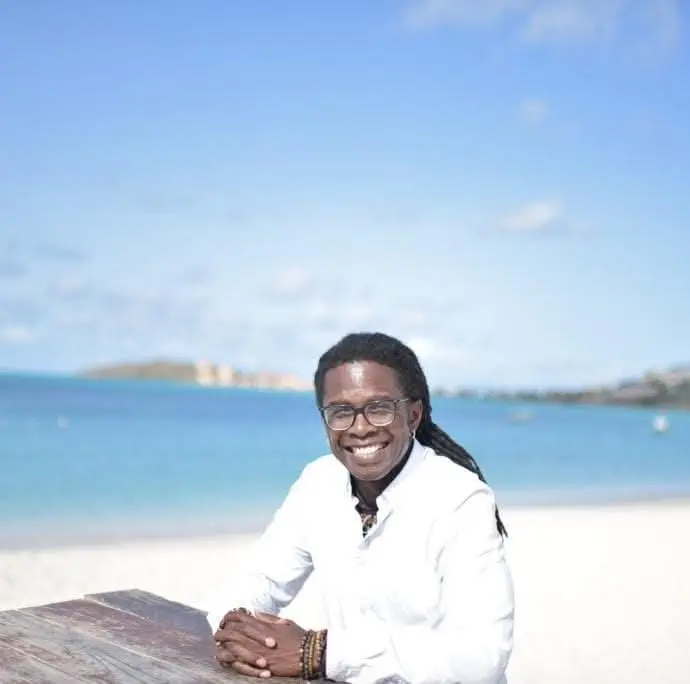
Francio Guadeloupe is an Aruban-born and partly St. Maarten-raised academic who started out in music. He worked for Arcade, both as a backing vocalist and a songwriter, for, among others, Dutch and international celebrities such as Bart Boos and Ray Slijngaard of Two Unlimited. He also co-organized tours of American superstars in Europe such as Usher and Keith Sweat.
All this while living in Germany. Guadeloupe: “What defines me is that I feel at home on both sides of the ocean. I have lived in various parts of the Caribbean, as well as in various parts of Europe. Even in the Netherlands, I have lived in towns ranging from the large city of Amsterdam to the tiny village of Aarle-Rixtel.”
Although he was offered opportunities to take the next steps in the music industry, he declined. The cliché of “Sex, Drugs & Rock ‘n’ Roll” was too prevalent in the scene for his liking. Instead, he pursued a path that proved to be a better fit: social work, and later, academia.
He worked as a community development officer in a wide variety of places across the Netherlands, helping minority groups address specific challenges. “From improving accessibility for people with disabilities to seeking to help establish a mosque for Muslim minorities.” Some initiatives worked; others did not. In certain areas, such as the outskirts of rural Noord-Brabant, he worked with people living with dementia, some of whom had never met or engaged someone of Caribbean descent. “Culturally, it always worked out. They often didn’t want me to leave.”
Career Change
He eventually became a platform coordinator for Dutch environmental NGOs, preparing for the stringent requirements associated with the Copenhagen treaty. NGOs, and the social sector in general, seemed to be his calling – until a special request came along.
As a master’s student at Radboud University in Nijmegen, he had completed a research project on the work of Catholic NGOs in Brazil. The project was well received and eventually led to a book, although an academic career was not something Guadeloupe had initially aspired to. “My supervisor and teachers, figures like Francien van Driel, Karin Willemse, and Tine Davids were brilliant. I later became a colleague of Tine at the Radboud University. They helped me finish my M.A. with a degree and published books.”
Remembering his book on Brazil, he was called and asked whether he would be interested in pursuing a PhD in a new project at the University of Amsterdam headed by the famed Prof. dr. Birgit Meyer. He got an interview and started his academic career.
“At the time, the world was going through a special period. The Cold War had come to an end, and international relations had become fluid in ways we were not accustomed to”. (Note by editor: see this article for the small but interesting cameo role St. Maarten / St. Martin had in this timeframe).
Francis Fukuyama and Samuel Huntington both, in their own ways, heralded a new era in international relations.”
Huntington predicted a “Clash of Civilisations”, in which religions and cultures would increasingly find themselves at odds. Guadeloupe was initially asked to study developments in Brazil.
However, he suggested changing the focus of the research. The multicultural microcosm of the Caribbean, with its ethnic and religious diversity, was a far more interesting region in which to study these developments.
He got his way. “This unexpected opportunity came along at just the right time, and brought me to the study of the Caribbean.” It would also mark the beginning of a period in which Birgit Meyer and Peter Geschiere, another leading anthropologist, would become important sources of inspiration.
From PHD to President of the University of St. Martin (USM)
The result was a book based on his 2006 PhD thesis, Chanting Down the New Jerusalem: Calypso, Christianity, and Capitalism in the Caribbean.
After completing his PhD, he spent six months at the University of St. Martin and another six months as a postdoctoral researcher at the KITLV-KNAW, an institute of the Royal Netherlands Academy of Arts and Sciences. After some time at Radboud University, he moved to the University of Amsterdam.
While his own PhD student, Jordi Halfman and Professor Yvon van der Pijl of Utrecht University with whom he chaired the Dutch Research Council’s (NWO) funded program “Imagining the Nation in the Classroom” helped oversee part of the research operation at the University of Amsterdam, Guadeloupe spent three years as president of the University of St. Martin – a role for which he is perhaps best known on the island.
Apart from his position as a professor at the University of Amsterdam, he remains involved in numerous projects relating to the Caribbean. Some focus exclusively on St. Maarten, while others cover the wider region. In every case, the Caribbean remains close to his heart.
One such project is Islanders at the Helm, which examines climate change across the six Dutch Caribbean islands.
“There is no understanding of the Caribbean without the sea. From that perspective, I like the Pelican monument near the St. Maarten Airport. The pelican, which is also a national St. Maarten bird, reminds us of the sea – that defining factor of island life.”
Another of his projects is Representing Europe. Demographic trends indicate that, from 2029 onwards, Europe’s population is expected to decline. “To sustain its economy, Europe is already seeing increasing immigration of skilled professionals from countries such as India and Nigeria. The Dutch Caribbean is also experiencing a greying population. St. Maarten included!”.
He clarifies the role of his research discipline:
“This is what cultural anthropology does: it studies human beings. Because humans live and think in contexts, we study those contexts, which are changing at different rates and for different reasons.”
The Kingdom as a Melting Pot
A third project is Public Anthropology of Kingdom Relations.
“I look at the islands and at how migration and cultural exchange have become intertwined. Within the Kingdom, you see languages adapting and evolving across cultures. Take the word ‘swa’, which means buddy in Papiamento, the language of the ABC islands (Aruba, Bonaire, Curacao). By now, you see groups of Dutch Moroccan descent and other segments of society adopting it. In Rotterdam, the Papiamento-derived expression ‘Hopi Hinderlijk’ has also become a familiar catchphrase for youth throughout the city. ‘Dushi’ is popular, too.”
This development does not entirely surprise Guadeloupe, who has come to realise that the Kingdom countries have more in common than they might think.
“As a Caribbean native with roots and routes in Aruba, Dominican Republic, Guadeloupe, Aruba, Saint Vincent, Carriacou and Petit Martinique, Trinidad & Tobago and St Maarten and Saint Martin, which means being a person born of the confluence of multiple African, European, American Indian and Asian cultural traces, I have learnt that while the continents may present themselves as being entirely different, Caribbean people show that the modern world we share is interconnected and interrelated. This has led me to see that the Netherlands and St. Maarten share more than people think. For instance, the challenges of people at the lower end of the labour market in both places are similar.”
This is compounded as Guadeloupe explains by the fact of migration within the Kingdom of the Netherlands.
“Some people have family in all four countries: St. Maarten, the Netherlands, Curaçao and Aruba. And let us not forget the Statia, Saba, and Bonaire links. The Netherlands, for example, has 194,000 citizens of Caribbean descent. That is more than Curaçao, the most populous Dutch Caribbean island, with approximately 155,000 inhabitants.”
Guadeloupe also worked on a film called Changa, about the newest generations of people of Caribbean descent living in the Netherlands. More than just a film, it was accompanied by a series of talk shows throughout the Netherlands.
The youngest generation of Dutch citizens of Caribbean extraction aspire to be successful on both sides of the Atlantic pond and identify accordingly. As with language, their sense of belonging is adaptable and versatile.
Guadeloupe sees young Caribbean professionals moving easily between the countries of the Kingdom.
“Changa – the desire to play a double-sided stone – is part of the philosophy of dominoes. Everyone is dealt a hand, but how do you play it, especially when you are shaped by multiple cultures?”
He also sees a growing trend of integrating the Caribbean countries of the Kingdom – St. Maarten, Aruba and Curaçao – into Dutch scientific funding programmes and research projects. In December the Scientific Council for Government Policy (WRR) will include all four countries in a single report. This is the first WRR report of its kind.
Caribbean Truths and Projects
From the very beginning, the Caribbean has been a kind of “Callaloo Soup”: an interesting mixture of cultures, as Guadeloupe argued in a paper of the same name.
When asked about the meaning of “Caribbean” beyond its literal definition, Guadeloupe makes a bold statement:
“The Caribbean started with a lie. Columbus did not meet ‘Indians’. The Carib Indians, contrary to popular folklore, were not cannibals. Even the etymology of the name Antilles, often used in Europe to refer to the Caribbean, is commonly explained incorrectly.”
Over time, the Caribbean has developed its own “truth”, or reality. Guadeloupe points out that Caribbean household recipes and cultural icons have also been shaped by external influences. “Mangoes originated in India, Bananas in Southeast Asia, breadfruit and coconut palms in the Pacific, and sugar cane originally came from Papua New Guinea. Over time, all these elements have become integral parts of Caribbean culture and cuisine.”
(In addition to being an anthropologist, Guadeloupe is an avid gardener – as his examples clearly demonstrate.)
All these influences have contributed to the development of distinct cultures over time.
“In the Caribbean, a person’s culture is, by default, multifaceted. The Bajan writer George Lamming, for example, was interested in his African roots and once travelled to West Africa. Initially, he recognised similarities in certain habits and practices. Later, however, he found the differences to be greater, leading him to conclude how distinct the Caribbean culture he came from had become over time.”
The shaping of truths is an ongoing process.
“That truth is constantly being reshaped and redefined, particularly following the abolition of slavery and contract labor. Today, most states in the region are either autonomous or independent. Paradoxically, however, there is also a growing recognition that cooperation is essential, whether within the Kingdom, CARICOM or another entity.
“I often say: if you want to understand the world, whether Europe or Asia, look at the Caribbean – a multinational and multi-ethnic microcosm. Minorities have been part of the region for a very long time. A noteworthy example is Eugene Chen, a Trinidadian-born Chinese man who went on to become China’s Foreign Minister.”
“Hidden Curriculums” In the Classroom
Given St. Maarten’s relatively recent nationhood in 2010, Guadeloupe is particularly proud of his Imagining the Nation in the Classroom project.
“The research examined how nationhood in the new country of St. Maarten, established in 2010, was perceived in elementary schools. It became apparent that whenever nationhood was addressed, ethnic considerations also came into play.”
“Because the nation is so ethnically diverse, a St. Maartener always takes other national identities into consideration. Teachers understand this and make room for Jamaican, Kittitian or Indian national narratives whenever they emerge.
“So, alongside education about St. Maarten and its heritage, there is also a ‘hidden’ curriculum, unique to the island’s diversity.”
How does St. Maarten fit into the Caribbean mosaic?
“St. Maarten is a miniature version of the Caribbean. If you want to understand the Caribbean in a nutshell, visit the island. It brings together Caribbean, Spanish, French, ABC-island, Dutch, Haitian and other influences.”
When it comes to academic discourse, which publications, authors or findings about St. Maarten does Guadeloupe consider particularly interesting, yet relatively unknown to the wider public?
“Historically, there was once a Dutch Creole dialect known as ‘Creole Dutch’, which was spoken on the ‘S’ islands: Saba, St. Maarten and Statia (St. Eustatius). It was also spoken on St. Thomas, which served as a refuge after British Admiral Romney nearly destroyed Statia in the wake of the island’s support for the American Revolution.
“The dialect did not disappear because of the English planters invited by John Philips in the eighteenth century, but rather later, when Americans began conducting business in the region in the early 1900s.”
Swimming and the Simpson Bay Strip
Guadeloupe received a lifetime honorary membership from the St. Maarten Hospitality & Trade Association (SHTA) in recognition of his work at the University of St. Martin (USM). This included connecting USM to international accreditation systems, guiding the institution through a challenging period and making broader academic contributions to the island and the region.
Although he resides primarily in Amsterdam, he returns frequently for work and family visits. What does St. Maarten mean to this cosmopolitan academic?
“It is one of my homes.” His favourite spot on the island remains Le Galion, on the French side of St. Maarten. He used to go swimming there every Sunday and misses those days. Friday evenings were often spent at Buccaneers or along the Simpson Bay Strip.
When it comes to dining, he enjoys vegetarian establishments such as Top Carrot and Ital Shack. His advice to visitors is to plan their stay around the St. Maarten Heineken Regatta.
What trends does he observe as an anthropologist who frequently visits and studies the island?
“Many more condominiums have been built, for example around Cupecoy. As a result, visitors no longer get to see the rest of the island or experience its Caribbean identity. In the past, tourists would sometimes visit local neighbourhoods.
“You would rent a car and get to know the person renting it to you. Car rental businesses used to be based in local neighbourhoods, allowing visitors to get a glimpse of everyday life. Nowadays, large buses pick up tourists, whereas in the past they would travel by taxi.
“Nowadays, there is much more separation between residents and visitors. People no longer feel as connected to the tourism economy as they once did.”
But complaining is not in his nature. In this respect, his grandmother, originally from the Dominican Republic, was a source of inspiration. Looking back, he believes she was more of a humanist than a religious person.
“She worked hard, without complaining.”