Did You Know… St. Martin Hosted A Meeting That Helped Shape the Post-Cold War World?
Uncertain Times
On December 16, 1989, the island of St. Maarten/St. Martin became the unlikely setting for one of the most important diplomatic conversations of the late twentieth century. And the meeting brought a supersonic plane to the island in the process, too.
United States President George H. W. Bush and French President François Mitterrand had decided to meet in the Caribbean to discuss a world that was changing faster than governments had been able to predict. Only weeks earlier, the Berlin Wall had fallen and communist governments across Eastern Europe were collapsing. Events that were partially driven by major political transformation in the Soviet Union under Mikhail Gorbachev, and now seemed to cascade. The Cold War order that had defined global politics for more than four decades was breaking apart.
1989: A world moving faster than diplomacy
The year 1989 had transformed international politics. Earlier that year Poland held partially free elections that weakened communist control. Hungary opened its border with Austria, and Czechoslovakia experienced the “Velvet Revolution”. Most importantly, East Germany faced growing protests and mass migration. Then came November 9, when the Berlin Wall fell.
Clearly, the collapse of communist rule had been a long-term objective of the United States and its allies. Yet the speed of change created serious questions.
A key question in the global balance of power was whether Germany would reunify. Tensions between Germany and France had played important parts in the escalation of European (and global) wars in 1871, 1914 and 1939. Whereas West-Germany and France were comparable in size with about 60 million inhabitants, a unified Germany would make the German population over 80 million overnight. Key to keeping Europe stable would be to keep this delicate axis between the old rivals coordinated. And exactly that was the complicated mission president Bush needed to embark on.
Another question was: Would the Soviet Union accept the loss of influence in Eastern Europe? Ever since the second world war, the Soviet Union had been one of the two global superpowers, carefully stitching a network of partners in Europe and beyond, leaning to socialist ideologies. Now it seemed at least in Europe, these ideologies had run their course.
That brought a third question: Would NATO remain relevant now its traditional foe seemed in demise? This required discussions with main military partners Britain and France, as well as other countries signatory to the treaty. In any regards, Bush wanted to avoid humiliating Moscow. He believed that a peaceful transition required cooperation with Gorbachev, while supporting the principle that European nations should determine their own future. Mitterrand did not reject German reunification per se, but wanted it connected to a stronger European framework.
The St. Martin discussions came shortly after the Bush–Gorbachev Malta Summit held on December 2 and 3, 1989. On the agenda of Bush and Gorbachev was amongst others arms control, European security and the changing relationship between the United States and the Soviet Union. Although neither leader formally declared the Cold War over, the meeting was widely viewed as a turning point.
After Malta, Bush continued consultations with European allies. His meeting with Mitterrand in St. Martin gave the American president an opportunity to discuss the future of Europe with one of its most influential leaders.
A Caribbean island at the center of Europe’s future
Somewhere along the post-Malta road, St. Martin was selected as Caribbean conference location. The choice of St. Martin for this summit was remarkable. Major diplomatic decisions were usually made in Washington, Paris, London, Bonn or Geneva. St. Martin was better known as a Caribbean destination than as a place where global security issues were debated.The island represented distance from the traditional political centers.
It was not the first conference the island hosted – sooner, the island already had experience with meetings, incentives and conferences at that time. Amongst others, the hotel now known as the Sonesta Maho Beach Resort was host to many Ford corporation business trips in the years previous.
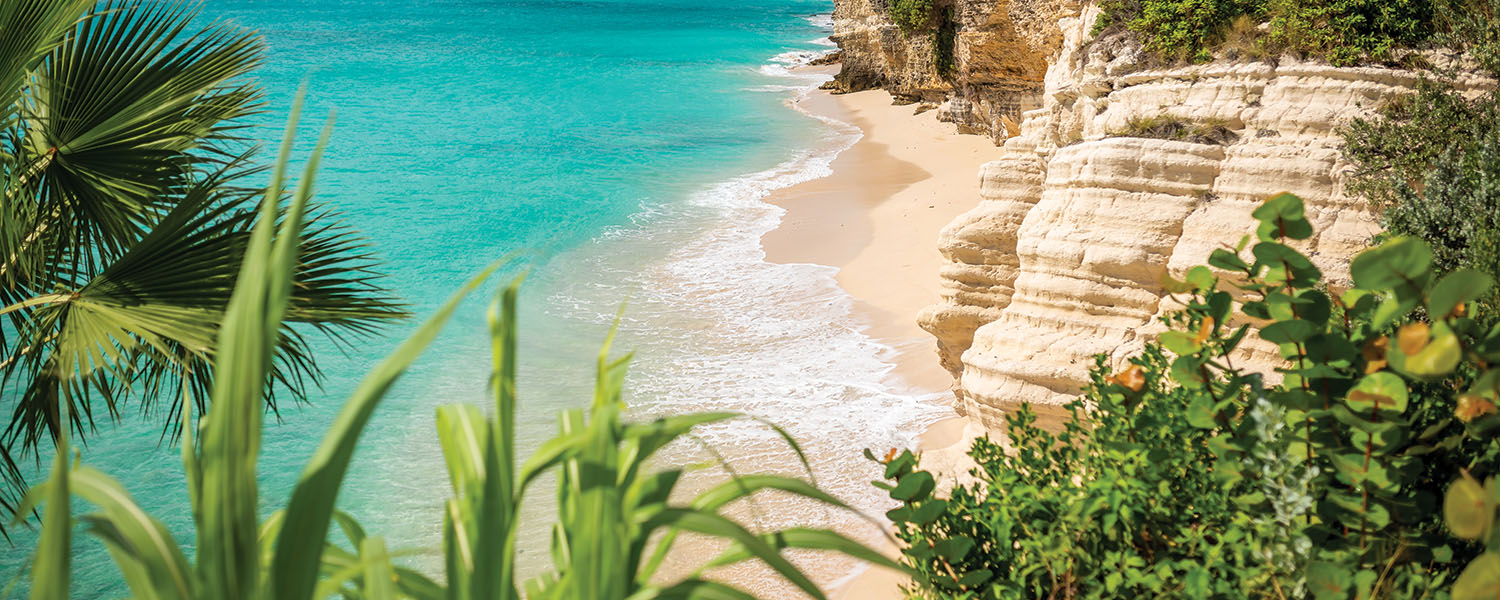
Safety, clearly, must have played a role in choosing the exact spot of the meeting. The island being a safe destination on its own merits, its geography also offered options for secluded retreats. The location of choice for the summit became the hidden cove of Anse Marcel on the northernmost tip of the island. With one road leading up to it, access was relatively easy to control for the French and American security details. From the seaside, the cove was easy to block too, with only one exit from the cove, facing Anguilla.
Last but not least, Anse Marcel came well equipped with a luxury resort to host the summit. L’ Habitation de Lonvilliers, almost symbolically named after Robert de Lonvilliers as one of the key persons in the 1648 meeting between Dutch and French officals dividing the island, was used to hosting exclusive meetings and guests. The secluded and informal environment allowed the two leaders to speak more freely, as the meeting was not designed as a public spectacle but as a moment for serious business.
Concorde and the symbol of a changing era
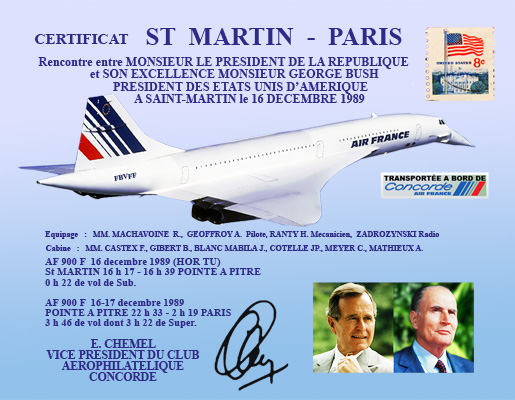
Secluded or not, there was a public spectacle in Mitterand’s arrival. His landing with a Concorde airplane added another unusual element to the story of the St. Martin meeting and led crowds to witness this (near) unique arrival over Maho Beach and its parking at Princess Juliana International Airport. Only once before, on February 6th 1981, for a publicity stunt, a passenger version of the Concorde touched St. Maarten soil.
Jean-Paul Le Moel, head of the Concorde division at the time, later stated landing the supersonic aircraft on the runway was not an easy feat, as the runway is shorter than what the plane used normally. He also recollected how the first visit in 1981 overshadowed the royal visit of Queen Juliana (ironically the royal the airport was named after) only shortly before.
For a diplomatic meeting, one could argue its presence was a power-play business card. The supersonic aircraft was one of the most recognizable symbols of technological ambition in the twentieth century. Apart from that, it was a product of Anglo-French cooperation, exactly the two allies President Bush needed to line up for a new European order. It was not just Mitterrand that Bush needed to align, but also Prime Minister Thatcher of Great Britain – another former enemy of Germany. For French leaders, Concorde demonstrated France’s technological capabilities and its ability to operate on a global stage. What better place to underline this technological marvel than on one of the most photographed beaches in the world, media present knowing an important and secret meeting was to follow?
For St. Maarten / St. Martin and visitors at the time, it was a unique experience of seeing this vast aircraft heading for the runway, or just seeing it parked at the airport. For a little while that is: as the presidents met, the Concorde made its way to park at Pointe a Pitre in Guadeloupe. Commemorative plaques of the unique arrival were issued and pictures of the combined sensation of the airplane and Maho Beach made headlines.
The decisions after St. Martin
The months following the meeting transformed Europe, and by extension world politics.
Within months, the process toward German reunification accelerated. The Two Plus Four negotiations between East Germany, West Germany and the four former occupying powers of Berlin eventually created the legal framework for reunification in 1990. Germany reunified on October 3, 1990. NATO survived the Cold War and adapted to a new security environment.
Mitterrand got his desires come true, too. The European Community moved toward deeper integration and eventually became the European Union.
In no way small St. Maarten / St. Martin was part of the global power play that it hosted in 1989 – but possibly, at least for one day, its scenic landscapes and bright Caribbean weather helped facilitate a positive global outcome.
Back to VISIT St Maarten / St Martin Main Page