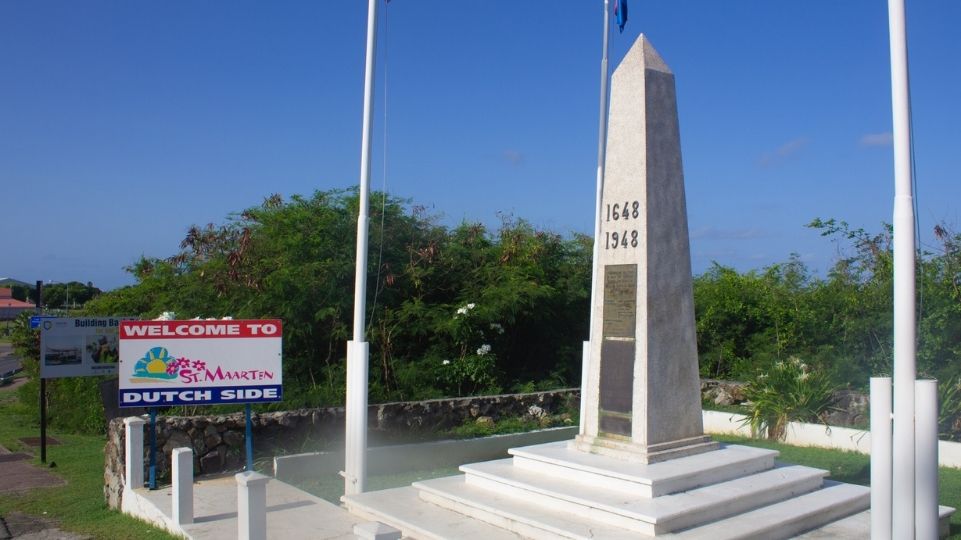
In 1948, a monument was erected to remember the 300th anniversary of the Treaty of Concordia, in which the French and Dutch divided the island into its current binational status. Where else would the monument be, except for exactly on the border between both, from Philipsburgto Marigot?
The monument is often depicted as symbol of binational unity between the two parts of the island. As a symbol of island unity, the monument is depicted in the national emblem and flag of Dutch side St Maarten, together with the national symbols of the Brown Pelican, the Courthouse and the Sage Flower. If the jade green hills around Concordia Monument appeal, you might want to stretch your legs your legs and enjoy them to the fullest via EPIC‘s Fleming property hiking trail! The monument is also depicted on the Sint Maarten / Saint Martin flag. Compared to the Dutch side of the St. Maarten flag, the monument is even more prominently displayed on the Unity Flag. Though the treaty was signed on March 23d, the binational St. Martin / St. Maarten unity is remembered at the monument on November 11th each year (St. Martin’s day). As the Kingdom of the Netherlands and the European Union have their border here, you will also often find their flags hoisted next to the monument.
Two important plaques can be found alongside the monument, commemorating the text and intentions of the treaty. One contains the treaty text. The other pertains the text of the speech by French side mayor Louis Constant Fleming held on the tricentennial treaty anniversary in 1948.
This appears to be a summarized, more recent version of the original. Among others, people present at the signing in older versions—such as Pitr van Zeun Hus (Pieter van Zevenhuizen)—are left out. The plaque also refers to the “Kingdom of the Netherlands” and the “Kingdom of France” as co-signatories. However, in 1648 the Netherlands was still a republic. The title of Stadtholder held by the Prince of Orange, as referenced, was hereditary and military in nature, but not monarchic in the absolute sense; the States General, also mentioned in the text, held significant political power. In any case, the Netherlands did not become a kingdom until 1813.
It is therefore possible that the cited wording stems from later treaty reaffirmations in 1817 (when the Bourbons under Louis XVIII were restored to the throne) or in 1839 (during the July Monarchy under Louis-Philippe). As it functioned more as a field agreement between colonial governors, its authority only later came from continued recognition by France and the Netherlands, reinforced through subsequent confirmations (such as in 1817, 1839, and 1957).
Also commemorated is the speech given by then French-side mayor L.C. Fleming, emphasizing the importance of good neighborly relations between the two sides.
“On that day, a party of Frenchmen and a party of Dutchmen met on the Mont des accords now known as Concordia Hill , and decided that instead of fighting for the possession of the entire Island they would agree on a friendly partition They furthermore decided that cordial relations should always exist between the inhabitants of both parts”
“What we are commemorating today is something much higher, much nobler . We are celebrating today the fact that for three hundred years , two populations of different nationalities have been living on a small Island without having had , during that long period , the slightest dispute or misunderstanding.”
Concordia Monument marks the border in between of Cole Bay and Marigot, close to the causeway bridge to Simpson Bay.
Concordia (1648) dividing the island between its characteristic Dutch and Frenc
Find The Concordia Monument on the map below!
The Concordia Monument is in the Cole Bay taxi zone. See our overview of St. Maarten taxi rates what pricing is in place from this location to your place of departure.
If you prefer not to take a taxi, the bus is a convenient alternative. The Concordia Monument lies directly on the Philipsburg–Marigot bus route, with minibuses passing by frequently throughout the day.
Back to Monuments Menu of Visit St Maarten / St Martin
Back to Main Page of Visit St Maarten / St Martin