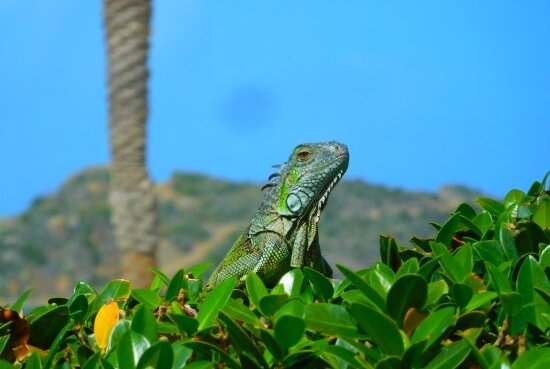
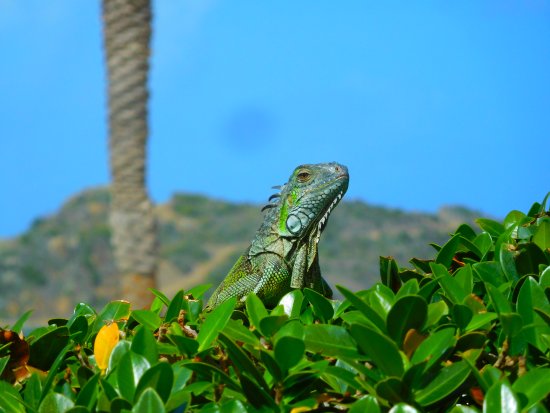
When visiting St. Maarten / St. Martin, you are likely to encounter an iguana at some point. These dragon-like creatures are harmless to humans and can be fascinating — and even amusing — to watch. For people living on the island, the biggest nuisance is discovering that an iguana has taken a bite out of a beautiful flower garden or a delicious vegetable plant.
When you encounter one, take a moment to notice its remarkable features. Iguanas have a small, light-sensitive organ on top of their heads called the parietal eye. It cannot see images like a normal eye, but it helps detect changes in light and may assist with predator awareness.
If threatened, an iguana can use its powerful tail as a defense mechanism. It can also drop part of its tail and regrow it over time.
Thirdly, iguanas are living solar panels. They are cold-blooded reptiles and often sit on rocks, walls, or tree branches in the sun to warm their bodies before becoming active. So, when you see one relaxing in the sunshine, rest assured that it is not being lazy — it is simply recharging.
While all of the above is true, that does not mean local organizations such as the Nature Foundation St. Maarten and museum Naturalis are not concerned about these little dragons that clearly feel at home on St. Maarten.
The reason is that the Iguana iguana, or green iguana, is not a native species to the island. It arrived in the 1990s and never left. Green iguanas are naturally found in parts of Central America, South America, and some Caribbean islands, but they were not historically part of St. Maarten’s native fauna.
They have changed the island’s ecology by taking over habitats that once belonged to the native Lesser Antillean iguana (Iguana delicatissima), which is now only found on a few islands, including Sint Eustatius.
One factor that has helped their spread is their rapid reproduction. Female green iguanas can lay large numbers of eggs, and in suitable environments, their populations can grow quickly. They are also excellent climbers and swimmers, allowing them to move between habitats and making population control difficult on islands.
Large populations can create ecological concerns because green iguanas may damage vegetation and, in some areas, are known to eat bird eggs.
A major concern is that green iguanas from St. Martin could spread to nearby islands where native iguana populations are endangered. This could create competition for resources and increase the risk of hybridization. Several Caribbean islands have struggled with introduced green iguana populations and their effects on native wildlife and agriculture.
During any visit to St Maarten’s nature, you are prone to see an Iguana. Large colonies can be seen on the road from Oyster Pond to Dawn beach near the Dawn Beach Club, on Pinel Island, and on the road from Oyster Pond towards French Quarter.
Find Iguanas and other Nature on Land on St Maarten / St Martin on our Interactive Map !
Back to Nature & Hiking Menu of Visit St Maarten / St Martin